
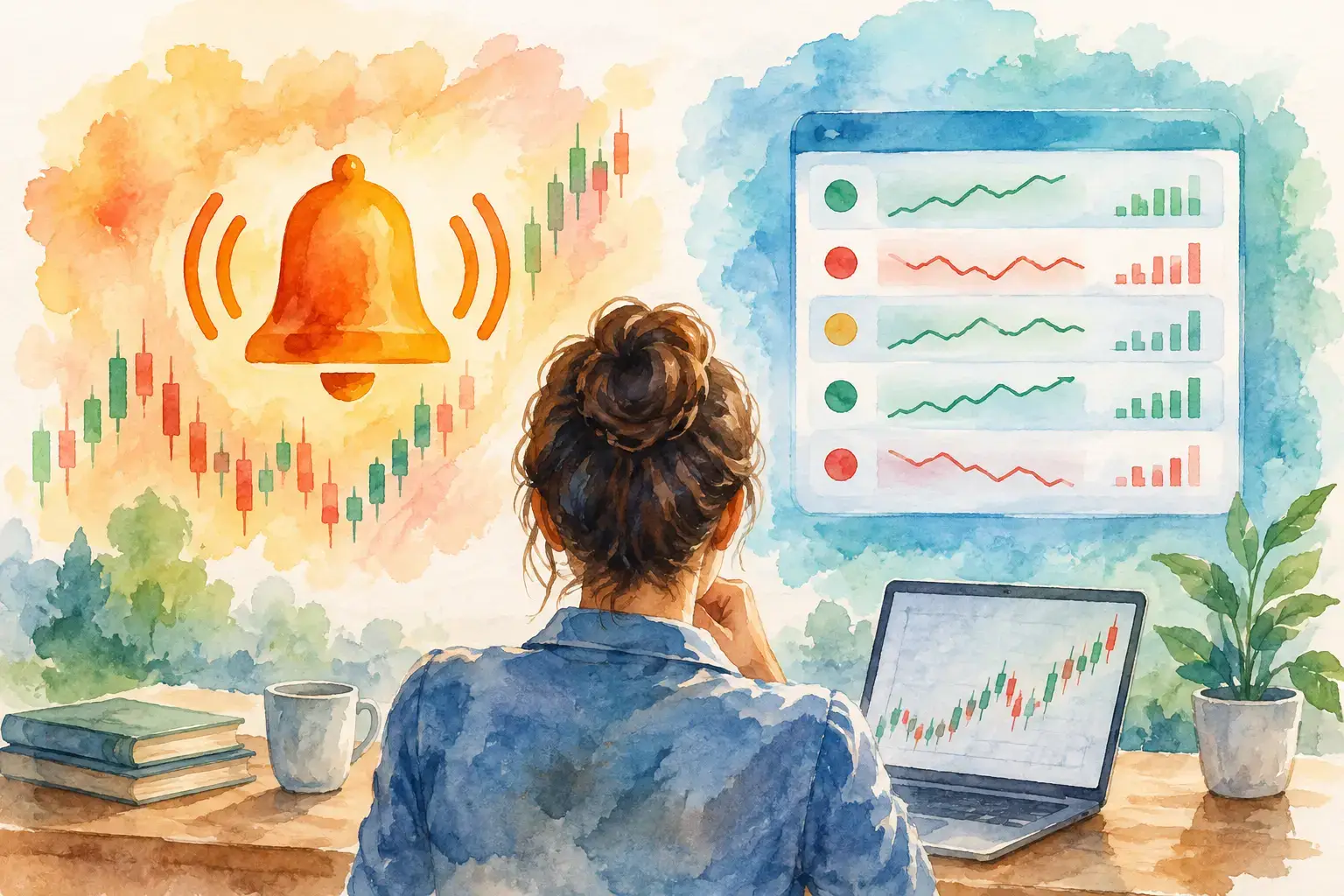
A stock that moves 8% at 10:17 a.m. is not automatically a trade. By the time a generic alert reaches you, the clean entry may be gone, volatility may be expanding, and your decision may be driven by urgency instead of a plan. That is the real distinction in alerts versus watchlists: one tells you something happened; the other tells you what deserves your attention before it happens.
Independent traders do not need more notifications. They need a process that reduces thousands of listed stocks into a manageable set of prepared decisions. A watchlist creates the field of focus. Alerts help you act when a prepared condition arrives. Used together, they can improve speed without turning your trading day into a reaction contest.
Alerts Versus Watchlists: Different Jobs, Different Value
A watchlist is a curated group of stocks you intend to study, monitor, or trade based on defined criteria. For an active trader, that usually means stocks showing relative strength or weakness, unusual volume, clean technical structure, earnings-related interest, a catalyst, or a setup that matches a tested model.
An alert is a notification tied to a specific event. It may trigger when price crosses a level, volume spikes, a moving average changes position, a new high or low prints, or a real-time signal appears. Alerts are event-driven. Their value depends entirely on the quality of the condition behind them.
Confusing these roles creates a common problem. Traders build an enormous watchlist, then expect it to behave like an alert system. Or they load up on alerts and assume every notification is a valid trade idea. Neither approach creates an edge.
Your watchlist answers: “What stocks should I be prepared to trade?” Your alerts answer: “Has one of my planned conditions occurred?” That sequence matters. Preparation comes first. Confirmation comes second.
Why Watchlists Should Lead Your Pre-Market Process
The market offers more opportunities than any individual trader can evaluate well. A broad scan may surface dozens or hundreds of names with movement, volume, news, or technical activity. Without a ranking process, every ticker can look equally urgent.
A disciplined watchlist solves that problem by forcing selection. Instead of following every stock with a headline, you prioritize names that meet measurable criteria. The best candidates are not necessarily the loudest stocks on social media or financial television. They are the stocks with evidence behind the setup.
For example, a useful daily watchlist may prioritize stocks based on relative performance against the S&P 500, trend quality, volume behavior, price location, and the historical behavior of similar setups. The exact factors depend on your strategy. What matters is that the list reflects a repeatable process rather than a collection of random ideas.
Keep the list short enough to know each chart. If you cannot explain why a stock is on your list, where it becomes actionable, and what invalidates the idea, it is not ready for execution. It is simply another ticker competing for attention.
A Watchlist Is Not a Portfolio of Predictions
Adding a stock to a watchlist does not mean you expect it to go up. It means the stock has earned additional attention. A bearish setup can belong on the same list as a bullish continuation setup. A stock near a major resistance level can be worth monitoring even if it never breaks out.
This distinction protects you from confirmation bias. The watchlist is a research tool, not a promise. Market conditions can change, sector leadership can rotate, and a strong-looking chart can fail at the open. Your job is to prepare for scenarios, not become attached to forecasts.
What Makes an Alert Worth Receiving?
An alert should represent a meaningful change in the trade decision. If a notification does not change what you might do next, it is probably noise.
Price-level alerts are useful when a stock approaches a planned entry, a breakout point, a support level, or a stop area. Volume alerts can help confirm whether a move has participation. Signal alerts can add another layer when they are tied to transparent rules and timestamps rather than vague labels.
The key is context. A breakout above yesterday’s high may matter if the stock is already on your watchlist, the broader market is supportive, volume is expanding, and the risk can be defined. The same alert may mean very little if the stock is extended, the sector is weak, or the move is occurring after a failed setup.
Do not treat an alert as an order ticket. Treat it as a prompt to check the chart, the market environment, and the plan you built before the opening bell.
The Cost of Too Many Alerts
Traders often respond to missed moves by adding more notifications. The result is predictable: phones buzz, screens flash, and attention gets divided across stocks that were never properly researched.
Too many alerts create a false sense of productivity. You may feel active while becoming less selective. That is dangerous because frequent prompts encourage impulsive entries, late chases, and decisions made without defined risk.
A better approach is to assign alerts only to priority names and only to levels or signals that matter to your strategy. If you trade opening-range breakouts, alerts should support that model. If you trade pullbacks in strong trends, set alerts near pullback zones and reclaim levels. Do not use a breakout alert for every stock in the market just because the feature exists.
The same rule applies to signal services. Timestamped signals and performance reports are valuable because they allow you to evaluate what happened, when it happened, and how the setup performed. But no signal eliminates judgment. A measurable edge gives you a framework. It does not remove market risk.
Build a Workflow That Uses Both
The strongest process starts before the bell. First, identify the stocks that meet your selection criteria and rank them by quality. Second, map relevant price levels, likely scenarios, and invalidation points. Third, create alerts that notify you when those preplanned conditions begin to develop.
During market hours, let the watchlist keep you focused and let alerts direct your attention efficiently. When an alert triggers, check whether the setup still matches the plan. Has the stock held its relative strength? Is volume confirming the move? Is the market helping or fighting the trade? Has price already moved too far from a logical entry?
After the session, review both the trades you took and the alerts you ignored. This is where many traders find the real leak in their process. Perhaps alerts are firing too late. Perhaps the watchlist is too broad. Perhaps your highest-ranked setups are producing better results than the names you add out of boredom.
A platform such as Most Excellent Investor can support this workflow by turning a noisy stock universe into ranked daily candidates, then pairing that preparation with real-time signals and measurable performance data. The point is not to outsource your decisions. The point is to arrive at those decisions with stronger evidence and less wasted motion.
When One Tool Matters More Than the Other
There are days when a watchlist matters more than alerts. This is especially true in choppy markets, when price can trigger levels repeatedly without follow-through. A focused list helps you wait for the best structure instead of reacting to every movement.
Alerts become more valuable when you cannot stare at every chart, when a stock is approaching a precise decision point, or when a fast market requires immediate awareness. They can also help experienced traders manage multiple prepared ideas without losing focus.
It depends on your trading style. A swing trader may rely heavily on end-of-day watchlist research and use fewer alerts. A day trader may use alerts throughout the session but still needs a tight morning plan. The principle remains the same: the alert should serve the watchlist, not replace it.
Measure the Process, Not Just the Outcome
A winning trade does not prove your process was sound, and a losing trade does not automatically mean the setup was poor. Track whether your watchlist names met their criteria, whether alerts arrived at useful moments, and whether you followed your planned rules.
Compare results across setup types and market conditions. Review alert-to-entry distance. Study whether volume, relative strength, or market direction improved the quality of triggered trades. If your edge cannot be measured, it is not an edge.
The goal is not to catch every move. The goal is to consistently recognize the moves that fit your process, define risk before entry, and execute without letting noise take control. Build tomorrow’s watchlist before the market opens, then make your alerts earn the right to interrupt you.