
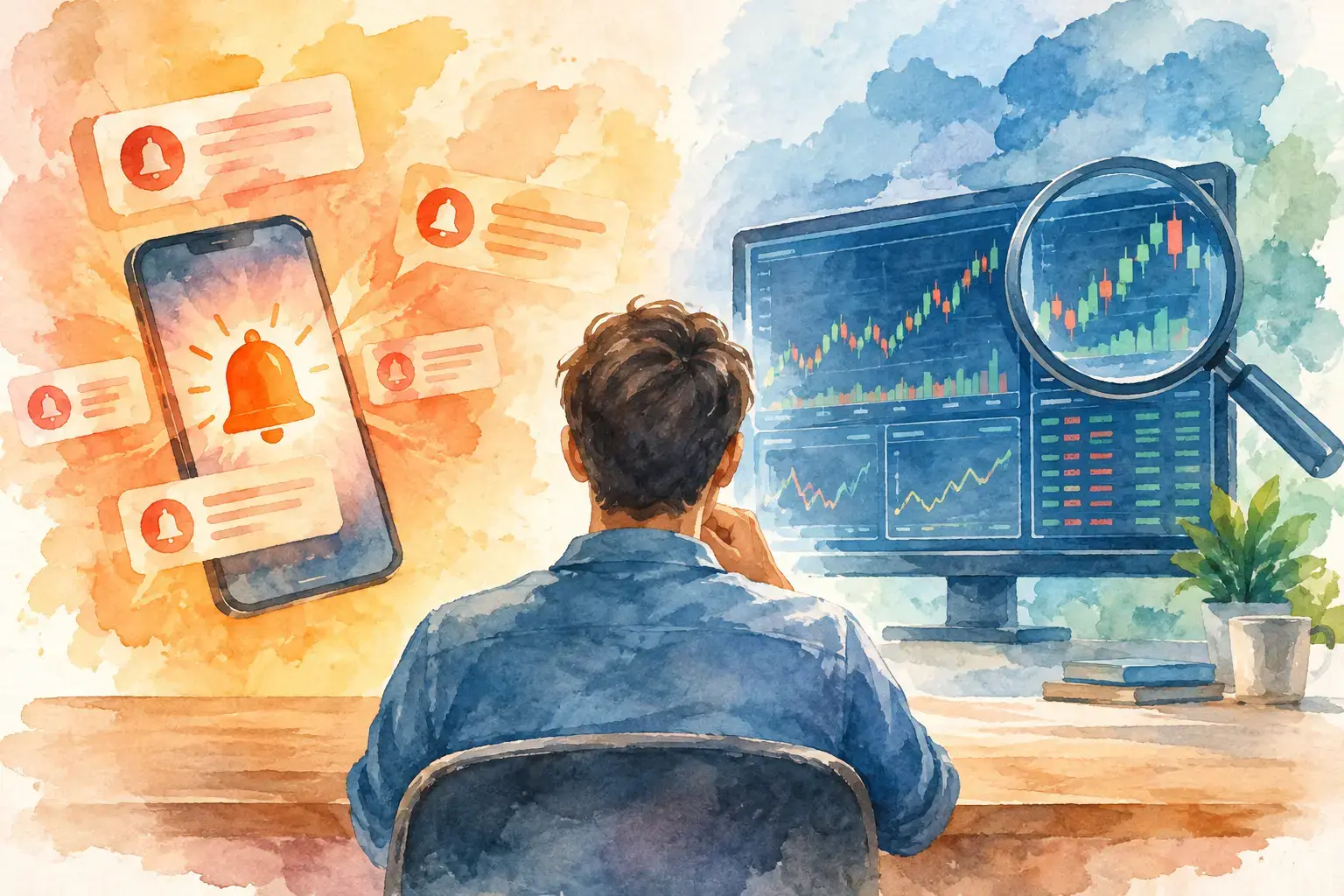
The question is not whether alerts versus scanners is the better tool. The question is whether you are using each tool for the job it was built to do. Traders waste hours trying to make a scanner behave like a real-time warning system, then expect alerts to organize an entire market. That confusion leads to late entries, overloaded watchlists, and trades taken without a plan.
A scanner helps you find opportunity. An alert tells you when an existing idea needs attention. Used together, they turn a market full of noise into a focused workflow: identify candidates before the open, define the levels that matter, then act only when price and conditions confirm your plan.
Alerts Versus Scanners: Different Jobs, Different Value
A stock scanner searches a broad universe using rules you set. Those rules can include price, volume, relative volume, gap percentage, moving averages, market capitalization, volatility, technical patterns, or performance over a defined period. Its job is discovery.
At 8:30 a.m., for example, you might scan for liquid stocks above a minimum price, up at least 3% pre-market, trading elevated relative volume, and holding above a key moving average. The result is not a trade signal. It is a smaller group of names worth evaluating before the opening bell.
An alert works from a different starting point. You already know the ticker and the condition you care about. You may set an alert for a break above pre-market high, a pullback to VWAP, unusual volume, a reclaim of a moving average, or a move through your planned stop. Its job is timing and awareness.
That distinction matters because neither tool replaces judgment. A scanner can show you a stock that fits your criteria but has poor liquidity, weak market context, or an exhausted move. An alert can fire at exactly the right level while the setup remains invalid because volume never confirms or the broader market turns against it. Tools create attention. Your process determines action.
What a Scanner Should Do Before the Market Opens
The best scanners reduce the number of decisions you need to make after the bell. They should not produce a 200-stock list that forces you to start your research from scratch. If your scan returns too many names, it is not filtering. It is simply moving the noise to a different screen.
Start with objective criteria that match your trading style. A momentum trader may prioritize relative volume, price strength, range expansion, and catalyst-driven activity. A swing trader may emphasize trend quality, constructive consolidation, and performance versus the S&P 500. A mean-reversion trader may look for extreme extension paired with a clear level of resistance or support.
The exact settings depend on your strategy. The discipline does not. Every filter should have a reason connected to a setup you have tested or reviewed consistently. If you cannot explain why a metric belongs in your scan, remove it.
After the scan runs, rank the results. Ranking is where raw data becomes useful research. A stock up 8% on significant volume is not automatically better than one up 3% with a clean multi-day base and sustained relative strength. Look for the names where price action, volume, liquidity, and market context align.
Your output should be a concise watchlist. For each ticker, define the relevant levels, identify the pattern you expect to trade, and decide what would invalidate the idea. This is the work that allows you to trade with conviction later. Most Excellent Investor is built around this principle: prioritize measurable candidates before the market opens instead of reacting to every ticker that starts moving after the bell.
A scanner is not a permission slip
A scan result is a research candidate, not a recommendation to buy or short. This is where many developing traders lose control. They see a stock at the top of a momentum scan and assume the move is still early. Often, the scanner is identifying strength after a large portion of the move has already happened.
Check the chart. Review the day’s range, recent resistance, volume pattern, spread, and whether the stock is trading cleanly enough for your risk tolerance. A great scan can find a stock worth watching. It cannot decide your entry, stop, target, position size, or whether the reward justifies the risk.
What Alerts Should Do During the Session
Once you have a prepared watchlist, alerts protect your attention. You cannot watch every chart every second, and trying to do so usually makes execution worse. Alerts let you monitor defined conditions without turning your day into a series of impulsive screen checks.
The most useful alert is specific. “ABC is moving” is not a trading condition. “ABC breaks the pre-market high on expanding volume” is closer to a condition you can evaluate. “ABC pulls back into VWAP after holding above the opening range high” is better still, assuming that is part of your playbook.
Price alerts are the starting point, but price alone is often incomplete. A level can break with weak participation and immediately fail. Where your platform supports it, pair price with context such as volume, time of day, percentage change, or an indicator confirmation. The goal is not to automate a decision you do not understand. The goal is to be notified when a researched setup becomes relevant.
Alerts also help you manage risk. Set them near invalidation levels, not only at potential entries. If a stock loses a key support area, you want awareness before hope takes over. A trader who receives an alert at a planned exit level has a chance to follow the plan. A trader who notices the loss 20 minutes later is more likely to rationalize it.
Avoid alert overload
An alert system with dozens of notifications is just another form of market noise. If every alert feels urgent, none of them are useful. Limit alerts to names on your active watchlist and levels that would actually change your decision.
A practical rule: every alert should answer one question. Is this stock entering my setup zone? Is my thesis confirming? Is the trade invalidating? Is price approaching a target where I need to reassess? If an alert cannot answer one of those questions, it probably does not belong.
The Stronger Workflow: Scan, Plan, Alert, Review
A disciplined workflow connects both tools instead of asking either one to carry the entire process.
Before the open, scan for stocks that meet the measurable traits of your strategy. Review the strongest candidates and build a short watchlist. Mark significant price levels, note the market and sector backdrop, and write down the setup you are willing to take. Define the point where you are wrong before you are in the position.
During the session, use alerts to pull your attention to those planned areas. When an alert fires, do not treat it as a command. Check whether the full setup is present. Is volume supporting the move? Is the market cooperating? Has the stock already extended too far? Does the entry still offer acceptable risk relative to your target?
After the session, review both the trades you took and the alerts you ignored. This is where your process improves. Did your scanner consistently surface names that fit your best setups? Were your alerts too early, too late, or too broad? Did you break rules after an alert fired because you had not defined the trade clearly enough?
Keep records with timestamps, entry logic, exit logic, and results. A trading edge that cannot be measured is not an edge. Over time, that data will show whether a scan filter adds value, whether a particular alert condition improves timing, and which setups deserve more attention.
When One Tool Matters More Than the Other
If you trade a small, stable list of large-cap stocks, alerts may matter more than scanners. You already know the names. Your challenge is staying patient until they reach meaningful levels.
If you trade momentum, earnings reactions, unusual volume, or fresh breakouts, scanners may carry more weight before the open. New opportunities appear every day, and discovery is a major part of the work. Even then, alerts become essential once you have narrowed the field.
For most independent traders, the answer is not choosing one side. It is assigning each tool a clear role. Scan broadly enough to find qualified candidates. Plan narrowly enough to avoid chasing. Alert selectively enough that a notification means something.
The market will always offer more tickers, opinions, and headlines than you can process. Your advantage comes from refusing to process all of them. Build a watchlist you can explain, set alerts tied to decisions you have already defined, and let preparation do the heavy lifting before price starts moving.